
Here’s a number worth pausing on: over 80% of physicians now use AI in their professional work. That’s according to the AMA’s own 2026 data — and it’s double what it was just three years ago.
I’ll be honest, even I didn’t see that pace coming. And I build this stuff.
I’ve been a practicing physician. I’ve also built SAFE-Triage, a clinical AI triage system that went through the full deployment cycle — the messy real-world version, not the polished demo. That double vantage point is why I think I have something different to say here than the typical tech review.
Most write-ups on clinical AI come from journalists who’ve never ordered a consult. So let me give you the view from the other side.
Why Adoption Actually Doubled
Nobody woke up and decided to start trusting AI. What happened was more specific than that — three separate walls cracked at the same time.
The documentation wall came down first. Doctors have been spending more time on charts than on patients for years. That’s not a technology problem. It’s a staffing and design problem. But ambient scribes hit differently because they attacked that specific pain point directly — not AI for AI’s sake, but AI that gave you forty minutes back at the end of your day.
The reliability problem got solved, mostly. The early clinical AI tools were general chatbots in a white coat. They’d hallucinate drug doses with total confidence. What changed was architecture: the tools that actually got traction in 2025 and 2026 are built strictly on peer-reviewed literature, with every answer sourced and citable. That’s a fundamentally different thing from “ask ChatGPT a medical question.”
And then institutions made the call. When Mount Sinai put OpenEvidence into Epic across all seven of their hospitals in March 2026 — for physicians, nurses, pharmacists — it stopped being a personal experiment. When your health system deploys a tool, you use it. That’s just how adoption works.
So here’s where things stand now.
Clinical Knowledge & Evidence Search
OpenEvidence
In March 2026, verified clinicians made one million queries to OpenEvidence in a single day. One day. The platform is now running around 15 million clinical consultations per month.
What they built is not an AI assistant. It’s an evidence retrieval system that happens to use AI. Every answer comes from peer-reviewed literature and clinical guidelines — and if the evidence isn’t there, it says so rather than filling the gap with confident noise. That design decision is the whole ballgame. It’s why it got cleared for Epic integration and why hospitals are willing to put it in front of nurses and pharmacists without a physician double-checking every output.
The Mount Sinai deployment now covers automated ICD-10 and CPT coding as well. That’s meaningful workflow time for anyone doing their own billing.
Use it for: point-of-care evidence synthesis, literature queries when you need the actual study not just a summary, differential support when you want to know what the meta-analyses say rather than what a model thinks.
UpToDate + Dragon Copilot
UpToDate is already embedded in something like 70% of clinical enterprises. I’m not going to try to convince you to use something you already have access to — but the 2026 addition of generative AI layered on top of its curated content, combined with the Dragon Copilot integration (now serving 600,000+ users), makes it meaningfully different from what you were using two years ago.
For anyone already inside a UpToDate enterprise environment: the AI synthesis is worth exploring. Familiar content, familiar interface, just faster retrieval.
Documentation & Ambient Scribes
ChatGPT for Clinicians
OpenAI launched this April 22, 2026 — free for verified U.S. physicians, nurse practitioners, and pharmacists. Verification required at sign-up.
The underlying model is GPT-5.4. In OpenAI’s own HealthBench evaluations, it outperformed human physicians on medical question accuracy. And 99.6% of responses were rated safe and accurate by physicians in their rating exercises.
Free. That’s the detail that matters most here. No enterprise negotiation, no IT approval cycle. You verify your license, you start using it.
What it does well: prior auth letters, patient education materials, summarizing literature you’ve already read, documentation drafting. It also tracks CME credit for evidence review sessions, which is a nice detail.
What it’s not: a clinical decision support tool the way OpenEvidence is. It’s broader in scope and therefore less constrained. For general-purpose clinical intelligence, it’s the most accessible entry point available right now. For evidence-based queries where you need guaranteed citation sourcing, OpenEvidence is the more trustworthy call.
HIPAA BAA is available for eligible accounts. Patient conversations are not used for model training. Those are the two questions that matter.
Ambient Scribes — Nuance DAX, Abridge, Suki
This is where the published evidence is strongest — stronger, actually, than almost anything else in clinical AI right now.
JAMA Network Open published a multi-center quality improvement study: 263 physicians across six U.S. health systems, 30 days with an ambient scribe. Burnout rate dropped from 51.9% to 38.8%. Thirteen percentage points in a month. After-hours documentation time, cognitive load, patient-facing attention during visits — all improved. A 2026 prospective observational study in JMIR Medical Informatics confirmed the pattern in a separate clinical setting.
These aren’t vendor numbers. These are peer-reviewed numbers from working clinicians.
The three main platforms do roughly the same thing but differ in where they fit:
Nuance DAX (Microsoft) makes the most sense if you’re already in an Epic environment with Dragon in place — it’s the path of least friction for health system deployment.
Abridge was built by physicians, and it shows in the interface design. Specialty support is broader than most.
Suki’s strongest advantage is UX. If you want something that doesn’t feel like enterprise software, Suki is usually the comparison winner.
DoxGPT
Doximity built DoxGPT into the platform that over 80% of U.S. physicians already use. The argument for it is simple: you’re already logging in. No new account, no context-switching, no IT ticket. If you want a single entry point and you’re a Doximity user, this is the lowest-friction option.

AI Diagnostic Tools — The Category I Think About Most Carefully
The FDA has cleared over 1,300 AI medical devices. About 80% are imaging-focused. The evidence in specific, narrow diagnostic tasks is real.
In radiology: AI-assisted chest X-ray reading cut turnaround time by nearly 50% while holding accuracy above 90% in one multi-center study. AI-assisted mammography screening finds approximately 17.6% more early cancers than standard reading — without adding false positives. Lung nodules, stroke, fractures, arrhythmias — there are FDA-cleared tools for all of these.
In pathology: PathAI and Paige both have FDA clearance for specific cancer detection workflows.
In dermatology: CNNs trained on large datasets have hit dermatologist-level accuracy for skin cancer detection in controlled conditions. Three FDA-cleared algorithms for diabetic retinopathy screening run at roughly 87–90% sensitivity and specificity.
Here’s what I want you to remember, though: every one of those numbers was measured in a curated, retrospective dataset. Not in your department. Not on your equipment. Not with your patient population.
FDA clearance means the tool passed a safety bar. It doesn’t tell you how it performs in your radiology suite on a Tuesday morning with your specific patient mix. That gap between benchmark and real-world deployment is where I’ve seen the most surprises when building clinical AI — and it doesn’t show up in the marketing materials.
Use diagnostic AI as decision support. Not as the decision.
Five Things I Check Before Adding Any Tool to My Workflow
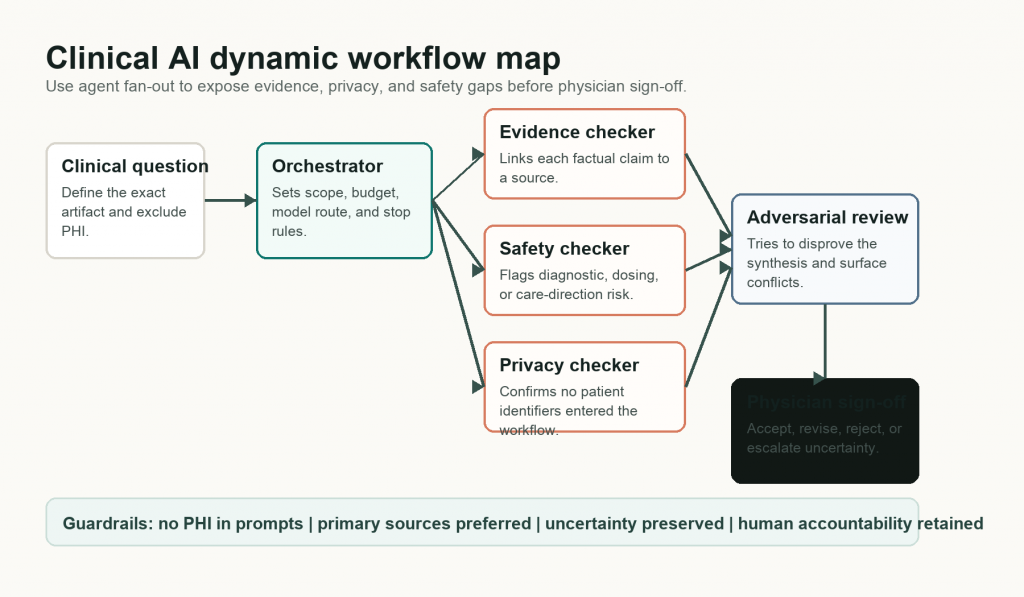
I’ll skip the numbered list. Here’s how I actually think through this.
First thing I want to know: does it cite its sources? Not just say it does — does it actually show me the study, let me click through? Confident-sounding answers with no citations are the most dangerous category in clinical use. That’s where hallucinations hide.
Then HIPAA. BAA available? Is my conversation data being used to train future models? For anything where patient information might enter the picture, both questions need clean answers.
Third is EHR integration — not because it’s philosophically important but because tools that require context-switching get abandoned. I’ve seen it happen with colleagues who genuinely liked a tool. If it’s not embedded in the workflow, it won’t survive clinical adoption.
After that: specialty fit. General clinical AI is calibrated on general medicine. If you’re in emergency medicine or dermatology or oncology, verify that the tool actually performs in your specific context before you rely on it.
And last — the one I think about most: your name goes on the note. AI generates suggestions. You make decisions. That’s not a limitation to work around. It’s the correct model for how this should work.
What Building SAFE-Triage Taught Me
The hardest part of clinical AI isn’t the training data or the model architecture. Those are engineering problems with engineering solutions.
The hard part is trust — specifically, what the tool does with edge cases. When the patient presentation is atypical. When the input is ambiguous. When the scenario isn’t well-represented in the training set. That’s where the gap between benchmark and real world opens up, and it’s not visible until you’re in production.
The tools earning real clinical adoption right now — OpenEvidence, the leading ambient scribes, the FDA-cleared imaging tools — they all share something. They were designed with a narrow scope and a clear failure mode. They know what they don’t know, and they’ll tell you.
The tools I’m more cautious about? The ones that answer everything with the same confident tone regardless of evidence quality. In clinical settings, expressed uncertainty isn’t a weakness. It’s how safe systems are supposed to behave.
Questions Physicians Actually Ask Me
Is ChatGPT for Clinicians actually free? Yes. Free for verified U.S. physicians, NPs, and pharmacists as of April 22, 2026. Verification required — you’ll submit your license information at sign-up.
Which tool has the most clinical users? OpenEvidence at 15 million consultations per month from verified clinicians. For ambient documentation, Nuance DAX through Dragon Copilot has the widest enterprise deployment.
Do scribes actually reduce burnout or is that vendor marketing? The burnout reduction data comes from JAMA Network Open — 263 physicians, six health systems, 30 days. It’s as peer-reviewed as anything in this space gets. The JMIR Medical Informatics 2026 prospective study confirms the pattern.
Are AI diagnostics going to replace radiologists? No. And the framing leads physicians to the wrong question. The useful question is: does this tool flag the cases I’d most want flagged, faster than I’d catch them alone? For mammography and certain radiology workflows, the answer is increasingly yes.
What’s the safest way to start if I haven’t used any of this yet? ChatGPT for Clinicians (free, broad, no institutional negotiation required) for general use. OpenEvidence for anything where you want cited evidence. Either ambient scribe platform offered by your health system if your documentation burden is the problem.
What are the real risks? AMA surveys put them in three buckets: data privacy, skill erosion from over-reliance, and acting on confident-sounding AI outputs that are wrong. The practical guard: BAAs for anything patient-adjacent, treat AI output as a first draft not a final answer, and keep your clinical reasoning as the primary process.
Where Things Actually Stand
Clinical AI in 2026 is not hype. The burnout numbers are real. The evidence retrieval improvements are real. The diagnostic detection rates are real.
It’s also not magic. The tools worth using are narrow, well-sourced, and honest about their limits. The ones worth being cautious about are the ones that aren’t.
If I had to give one recommendation to a colleague who hasn’t started yet: pick one tool, one use case. ChatGPT for Clinicians if you want broad capability and free access. OpenEvidence if your main need is evidence-based queries. An ambient scribe if after-hours documentation is eating your evenings.
Don’t try to adopt the whole landscape at once. None of the physicians I know who use these tools well did it that way.
Dr. Ahmed Zayed, MBBCh — Physician, Clinical AI Builder, Applied Health Informatics (RWTH Aachen)
Medical disclaimer: This article is for informational purposes only. Clinical AI tools should be evaluated within your specific institutional context, patient population, and regulatory environment. AI outputs in clinical settings require physician review before action.

Licensed physician and clinical AI specialist. Founder and Editor-in-Chief of ZayedMD, a physician-led medical publication covering clinical AI, neurology, metabolic health, and evidence-based patient guidance.