
Physician-Led Operations Review
Author: Dr. Ahmed Zayed, MD
Artificial intelligence is shifting from experimental piloting to system-wide deployment. Because of this, Chief Medical Information Officers and healthcare leaders face a new set of clinical, operational, and legal responsibilities. Legacy software is relatively predictable. However, generative AI and ambient clinical scribes introduce dynamic risks such as medical confabulation (hallucinations), algorithmic drift, and sensitive data leakage.
If you’re wondering how to safely introduce these tools into your hospital system, you are not alone. It is essential to have an all-rounded strategy before integrating any new technology. In this blog post, we will discuss the operational checklist you need to evaluate, procure, and audit clinical AI systems at your institution.
1. Legal and Data Privacy Guardrails
Before conducting clinical pilots or sharing patient data, you must verify the vendor meets strict healthcare data governance standards.
- [ ] Execution of a HIPAA Business Associate Agreement (BAA):
The vendor must execute a standard BAA. You should resist from accepting general terms of service or corporate software agreements that lack explicit HIPAA liability. - [ ] Zero Data Retention for Ambient Audio:
Audio streams processed during ambient scribing must be deleted immediately after note generation. No raw audio files should be cached, stored, or logged permanently on vendor servers. - [ ] Model Training Opt-Out:
You should obtain written and contractual confirmation that patient-physician interaction data, transcriptions, and medical notes are never used to train the vendor’s foundation models. In some cases, vendors might share this data with third-party model providers, which you must block. - [ ] Encryption Standards:
Verify the system uses AES-256 encryption for data at rest and TLS 1.3 for data in transit. - [ ] Data Residency:
Confirm that all data processing, storage, and backup occurs on sovereign cloud infrastructure compliant with local laws, such as US-only, EU-only, or regional GCC instances for Saudi or UAE deployments.
If you are worried about data leaks or regulatory non-compliance, you can rest assured that checking these baseline security measures will protect your patients and your organization.
2. Accuracy, Safety, and Verification Frameworks
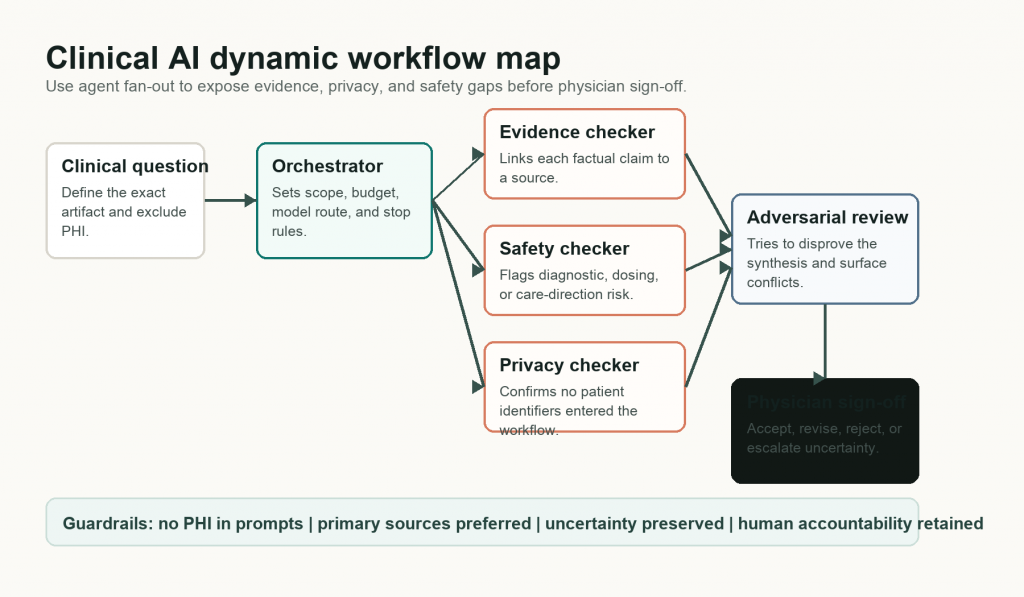
AI systems are statistical prediction engines. To prevent clinical errors, you must ensure safety verification is embedded directly in the clinician workflow.
If you’re wondering what safety guardrails look like in practice, the most essential step is implementing a strict staging versus committing rule. The integration must place all AI-generated text, coding recommendations, or orders into a “Pending Review” queue. You must never allow an AI system to commit clinical documentation or orders to the EHR without a physical sign-off (electronic signature) from a licensed clinician.
Acoustic disambiguation is another critical safety area. You must test the ambient system’s accuracy with phonetic pairs that have critical clinical implications. For instance, the system needs to correctly distinguish between “hypo-” and “hyper-” in conditions such as hypoglycemia and hyperglycemia. It must also accurately capture numeric dosages, distinguishing fifteen milligrams from fifty milligrams, and separate medication names with similar sounds, such as Xanax and Zantac.
Evaluating how the model responds to incomplete or highly ambiguous patient encounters is also essential. A safe model must explicitly state its inability to document a section or decline to answer, rather than confabulating a plausible-sounding but fabricated clinical detail. To support this, you should ensure the system’s underlying models are validated against standardized medical dictionaries, such as ICD-10-CM, SNOMED-CT, RxNorm, and CPT terminologies.
Rest assured that by enforcing these strict verification frameworks, you can significantly reduce the risk of clinical errors.
3. Integration, Architecture, and Interoperability
A tool that does not fit the clinical workflow increases administrative burden and cognitive fatigue. Let’s take a look at the technical specifications you need to look out for.
- [ ] Standardized Interoperability (FHIR / HL7):
Ensure the platform reads and writes data using modern HL7 FHIR (Fast Healthcare Interoperability Resources) APIs, avoiding proprietary, fragile database connectors. - [ ] Write-Back Capabilities:
Confirm whether the scribe supports native write-back to specific note fields, such as HPI, Objective, Assessment and Plan, rather than requiring copy-pasting or dumping the entire interaction into a single raw text field. - [ ] Hardware Compatibility:
Audit mobile application performance across active hospital devices, such as iPhones, iPads, and Android devices. It is also wise to verify microphone sensitivity under real-world background noise conditions, such as HVAC hums and hallway conversations. - [ ] Forensic Audit Logging:
The system must log the exact timestamps of note generation, the specific model version used, and capture any manual edits made by the clinician to the AI-generated draft.
If you’re wondering why clinical integration is so essential, it is because smooth workflows prevent physician burnout, and you can rest assured that modern FHIR integrations make this transition much easier.
4. Post-Deployment Monitoring and Lifecycle Governance
Clinical AI safety does not end at procurement. Models drift, software updates occur, and patient demographics shift. Let’s get into the details!
To monitor algorithmic drift, you should go for quarterly spot-audits. A clinical safety committee should compare fifty random AI-generated notes against the original audio or transcription to measure semantic accuracy over time.
Moreover, you must establish change management controls. The vendor must contractually agree to notify the CMIO at least fourteen days prior to pushing any major updates to underlying Large Language Models or changing clinical prompts.
Finally, you should conduct bias and demographic auditing. This involves reviewing transcription and comprehension accuracy across diverse patient cohorts, preferably looking at performance for patients with accents, non-English primary speakers, and varying age groups.
If you feel anxious about long-term software changes, rest assured that setting up these scheduled evaluations will keep your system accurate and safe.
Conclusion
This operational safety checklist is curated for clinical leadership. All deployments of clinical AI must be customized to fit your regional laws, institutional risk policies, and EHR specificities.
Get the ZayedMD AI Healthcare Brief:
Join thousands of clinicians and builders receiving twice-weekly, physician-led intelligence on clinical AI safety, regulations, and implementation strategies.
👉 Click here to subscribe to the ZayedMD newsletter

Licensed physician and clinical AI specialist. Founder and Editor-in-Chief of ZayedMD, a physician-led medical publication covering clinical AI, neurology, metabolic health, and evidence-based patient guidance.