
ICD 10 Memory Decline: Causes & When to See a Doctor
It starts with a few events that make the family laugh. You search hours on end for the car keys, only to find that they were left in a very obvious location, yet you end up being late for work. You misplace your smartphone and forget that there is a simple way to track it. While these go unnoticed, you start to worry when you forgot about a good friend’s birthday, or suddenly you cannot recall a phone number that you have had stuck in your head for years.
There are many reasons for declining memory, and general memory loss is a reality for millions of people. While often associated with problems like Alzheimer’s disease, there are many people who experience memory-related problems due to other issues. Recent studies and publications have also noted a rise in the incidence of memory problems among the younger population as well.
How Memories Are Formed
Memories play a crucial role in the everyday lives of the human population. We rely on memories for a lot of things – remembering birthdays, names, phone numbers, past events – these all give meaning to our lives. Memories help to guide our behavior, and it assists with information processing in multiple ways.
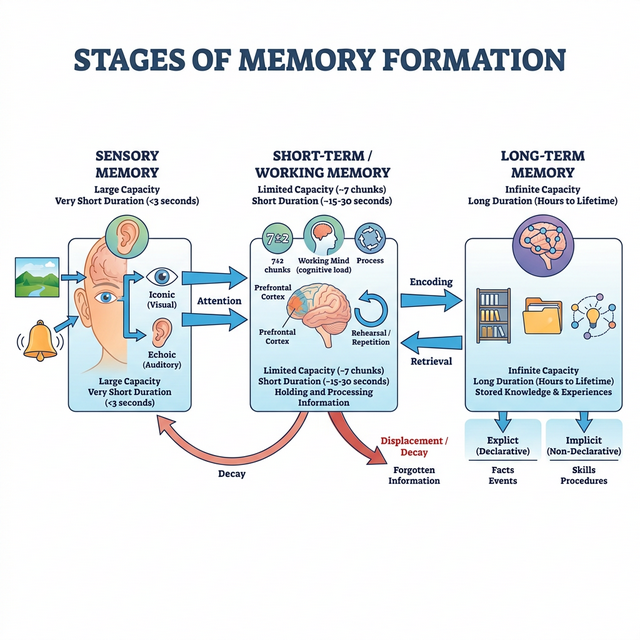
There are different stages in which a memory is formed. The three types or steps that occur during the formation of a new memory include:
– Sensory register
– Short-term memory
– Long-term memory
The sensory register stage takes place within just a couple of seconds. Short term memory is often referred to as working memory as well. This is the type of memory that is stored for a temporary period of time. Not all memories will proceed toward the “long-term” stage, but those that do tend to stay stored in what some may refer to as a “memory bank.”
Long-term memory is also divided into multiple types. These typically include implicit and explicit memories. Additional categories include Episodic memories, as well as Semantic memories.
Why Memory Loss Occurs
Memory loss can affect anyone. Even though this is an issue that older people tend to experience more commonly, it is important not to overlook the fact that a lot of younger people also tend to have memory-related problems in the modern-day.
It is important to understand that there are quite a large number of potential causes behind memory loss. In some cases, the reason why a person suffers memory problems may be due to the presence of an underlying disease.
Non-Disease Related Memory Loss

A lot of people think that once they start having memory problems, then they are developing a disease. Fortunately, this is not true in a large number of cases – especially when we consider memory-related issues in young adults. In these cases, there is often an explanation other than an underlying disease that could provide clarity over why the person is experiencing these symptoms.
Some of the potential causes behind memory loss that are not linked to a specific disease may include:
– Medication use (antidepressants, anti-anxiety drugs, sleeping pills, muscle relaxants, antihistamine drugs, tranquilizers, certain pain medicines)
– Excessive tobacco or alcohol use.
– Depression and anxiety disorders.
– High levels of stress.
– Insufficient sleep.
– Certain nutritional deficiencies, especially vitamin B12 and vitamin B1.
Disease-Related Memory Loss
While many cases of memory loss can be linked to a non-disease related potential cause, it is important not to overlook the fact that there are certain conditions that can lead to memory-related problems.
Alzheimer’s is definitely the most common problem that leads to the development of memory loss as a symptom. Apart from Alzheimer’s disease, other possible conditions that need to be taken into account here include:
– Vascular dementia
– Frontotemporal dementia
– Huntington’s disease
– Lewy body dementia
– Mild cognitive impairment
– Corticobasal degeneration
– Creutzfeldt-Jakob Disease
– Progressive Supranuclear Palsy
Is It Time To See A Doctor?
While it is not always a call for concern when memory-related problems occur, when there is no obvious factor to explain these events, it might be time to consider paying your doctor a visit. Even when there is nothing to be especially concerned about, it is, of course, better to get a check-up and to have any problems detected at an early stage.
It is generally advised to see a doctor when the memory loss does not improve or when accompanying symptoms also start to develop. Furthermore, when these memory-related issues cause significant interference in a person’s daily life, then it might also be a good idea to see a doctor.
The doctor will ask the patient a number of questions. Thus, before going to the doctor, be prepared with some answers may be useful as well. Having an estimated time when the memory loss symptoms showed up would definitely help the doctor. Any recent changes to the person’s lifestyle, such as taking a new medication, for example, could also assist with a diagnosis.
Conclusion
The development of memory-related problems can sometimes indicate the presence of an underlying disease, which could require a diagnosis and appropriate treatment. In other cases, however, this may be a complication caused by drugs or other factors in a person’s life. There are scenarios where the memory loss can be reversed, but in some cases, existing damage cannot be undone, but further damage and symptoms could potentially be stopped or at least slowed.
Short 50 Word Version
Memory loss is a common problem. While the occurrence of this symptom may be worrisome, it may not always indicate the presence of an underlying health condition. There are cases when it may be advisable to see a doctor, such as in cases where a sudden onset of memory loss and related problems occur.
References
https://www.health.harvard.edu/mind-and-mood/memory-problems-at-a-young-age
https://lesley.edu/article/stages-of-memory
https://www.webmd.com/brain/memory-loss#1
https://www.ucsfhealth.org/conditions/memory_disorders/

Licensed physician and clinical AI specialist. Founder and Editor-in-Chief of ZayedMD, a physician-led medical publication covering clinical AI, neurology, metabolic health, and evidence-based patient guidance.